If you’ve lived in Lagos long enough, you’ve had a pest encounter.
Maybe it was a cockroach in the kitchen that disappeared behind the fridge when you turned on the light. Maybe it was the small dark droppings under your sink that confirmed what you suspected. Maybe you woke up to bites on your arms that weren’t there when you went to bed, and two days of investigation later you found bedbugs in the seam of your mattress.
Pests in Lagos homes are not a sign of poor housekeeping. They’re a function of the city’s climate, building density, drainage infrastructure, and the constant movement of people and goods. The heat, humidity, and abundance of food sources create near-ideal conditions for cockroaches, bedbugs, mosquitoes, rats, termites, and ants to thrive.
What separates Lagos homeowners who stay ahead of pest problems from those who deal with full infestations is simple: regularity and professionalism. This guide gives you everything you need to know about fumigation in Lagos — what it covers, how often you need it, how to prepare, what to expect, and what it should cost.
First: Fumigation vs. Spraying — What's the Difference?
These terms are used interchangeably in Lagos but they’re not the same thing, and the distinction matters for what you’re trying to achieve.
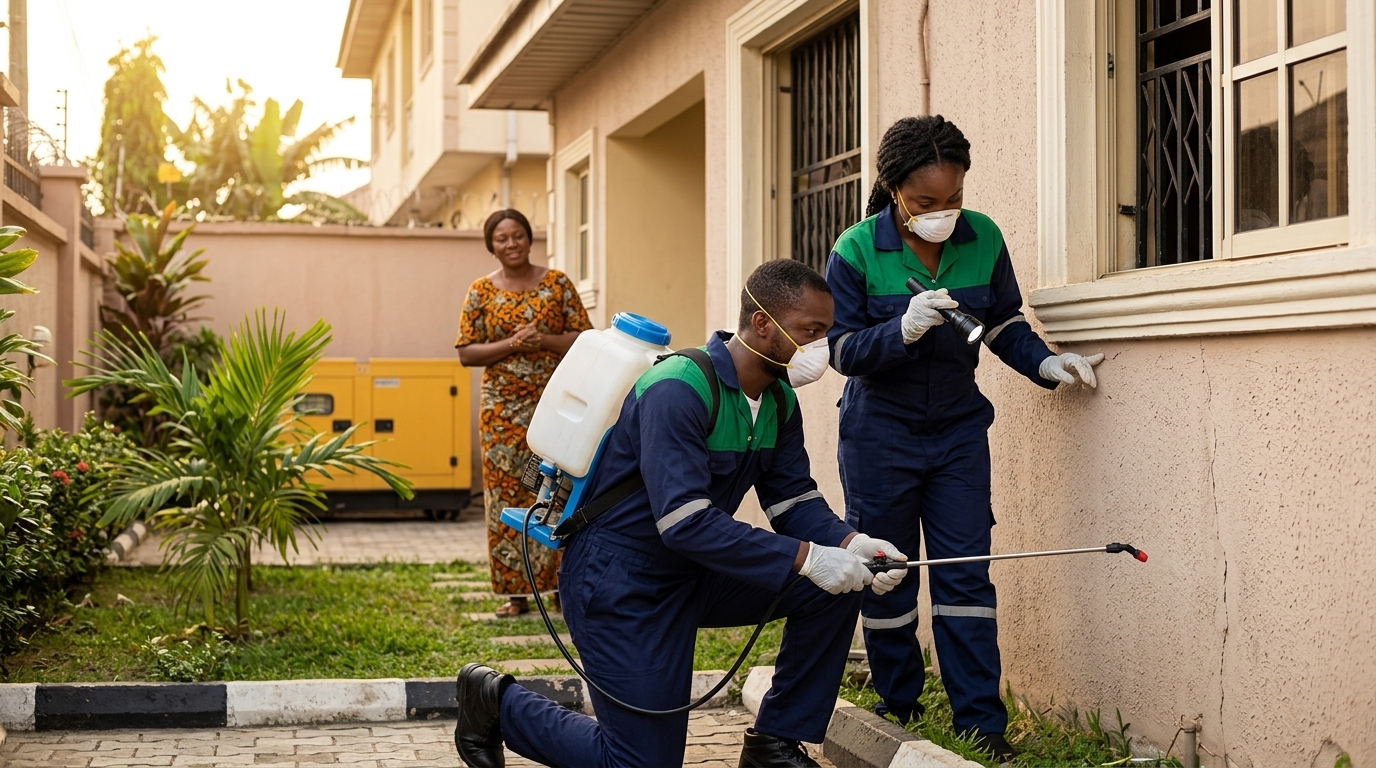
Spraying (sometimes called surface treatment) is the application of liquid pesticide to surfaces — walls, floors, behind furniture, under sinks, around door frames. It targets pests that crawl through or rest on treated surfaces. It’s effective for cockroaches, ants, mosquitoes, and similar surface-active insects. Most pest control visits in Lagos involve spraying.
Fumigation in the strict technical sense involves sealing an entire space and filling it with a gaseous pesticide (usually methyl bromide or phosphine) that penetrates every crack, void, and cavity. True fumigation is typically used for severe termite infestations, grain storage, or shipping containers. It requires the building to be completely vacated and sealed.
In everyday Lagos usage, when people say “fumigate my house,” they almost always mean a professional spray treatment — and that’s what most pest control companies provide. When booking, it’s worth asking exactly what chemicals and methods will be used, what pests the treatment targets, and what the expected duration of effectiveness is.
This guide uses “fumigation” in the Lagos sense — professional pest treatment that goes beyond a DIY spray can.
If you’re experiencing any manner of pests, don’t hesitate to call us.
[Service Paddy handles emergency pest control across Lagos] WhatsApp us at 08098986241 for immediate response.
Why Lagos Homes Are So Vulnerable to Pests
Understanding why helps you prevent re-infestation after treatment:
The climate is ideal for insects. Lagos temperatures average 26–32°C year-round — right in the breeding sweet spot for cockroaches, mosquitoes, ants, and bedbugs. There’s no cold season to kill eggs or drive populations down.
The rainy season drives pests indoors. From April to October, heavy rainfall floods outdoor pest habitats. Cockroaches, ants, and rats move into buildings seeking dry ground. Pest activity spikes noticeably after heavy rain.
Open drainage systems. Lagos’s street drainage channels — open gutters running alongside most roads — are breeding grounds for mosquitoes, cockroaches, and rats. Homes within a few metres of these channels are significantly more exposed.
Building construction gaps. Most Lagos buildings have gaps around pipes, conduit entries, and door frames that provide easy access for cockroaches, rats, and lizards. Unless these entry points are sealed, treatment provides limited protection.
Shared building walls. In blocks of flats, terrace houses, and compounds, pests move freely between units through shared walls, ceiling voids, and drainage pipes. Treating your flat while neighbours don’t creates only partial protection.
Food storage habits. Many Lagos households keep significant food stores — large bags of rice, garri, beans, dried fish. These attract rodents and pantry insects if not properly sealed.
What Professional Fumigation in Lagos Covers
Cockroaches
The most common pest complaint in Lagos. German cockroaches (small, light brown, found in kitchens and bathrooms) and American cockroaches (large, dark, usually from drainage) both thrive in Lagos conditions.
Professional treatment involves:
- Residual insecticide spray to surfaces where cockroaches travel and rest
- Gel bait placed in cracks and hiding spots (cockroaches carry the bait back to the nest, killing the population at the source)
- Treatment of drain openings, which are primary entry points
Cockroach infestations are graded by severity. A light infestation responds well to a single treatment. Heavy infestations — where cockroaches are visible in daylight, or where numbers are in the hundreds — typically require two treatments 2–4 weeks apart to break the breeding cycle.
Bedbugs
Bedbugs are the hardest Lagos pest to eliminate. They hide in mattress seams, bed frames, headboards, skirting boards, electrical outlets, and even behind wallpaper. They reproduce rapidly — a single pregnant female can establish a full infestation within weeks. They’re also developing resistance to several common insecticides.
Effective bedbug treatment requires:
- Full inspection before treatment to map all hiding locations
- High-concentration residual spray to all identified hiding areas — not just the mattress
- A follow-up treatment 10–14 days later to kill newly hatched nymphs (which weren’t yet exposed to the first treatment)
- Heat treatment in severe cases (the most effective but most expensive option)
If a pest control company tells you bedbugs can be eliminated in a single visit with spraying alone, be sceptical. The follow-up treatment is essential.
Mosquitoes
Beyond the discomfort, mosquitoes in Lagos carry malaria and dengue fever. Treatment focuses on:
- Knockdown spray (immediate kill) for adult mosquitoes inside the building
- Residual surface treatment for resting areas (walls, curtains, ceiling)
- Larviciding — treating standing water sources where mosquitoes breed (including drains, water containers, gutters)
Mosquito treatment without addressing breeding sources provides only temporary relief. If you have water tank or drainage issues, mosquitoes will keep returning regardless of how often you spray.
Rats and Rodents
Rats in Lagos homes are commonly either the Norway rat (large, burrows underground) or the roof rat (smaller, climbs, lives in ceiling voids and roofspaces).
Rodent control involves:
- Bait stations placed in rodent pathways (along walls, behind appliances)
- Snap traps for immediate knockdown
- Exclusion — identifying and sealing entry points (critical for long-term control)
Rodent control without exclusion is an ongoing battle. If the entry points — gaps around pipes, holes in walls, broken vent covers — aren’t sealed, new rats will continue to enter. Our handyman team can handle the sealing and repair work that makes pest control actually stick.
Termites
Termites are the most structurally damaging pest in Lagos. They consume wood from the inside, often leaving surfaces intact while hollowing out the structure beneath — meaning damage can be extensive before it’s visible.
Signs of termites:
- Mud tubes running up walls or along skirting boards (termites build these to travel above ground while staying protected)
- Wood that sounds hollow when tapped
- Discarded wings near windows and doors (during swarming season)
- Bubbling or blistering paint on wooden surfaces
Termite treatment requires soil treatment around the building’s foundation, wood treatment on affected timber, and in severe cases, physical barriers. This is one of the more involved pest control services and should only be carried out by an experienced professional.
Ants
Ants in Lagos range from small nuisance kitchen ants to the much more aggressive driver ants that can briefly take over a building in columns. Standard spray treatment handles most ant species effectively, but finding and treating the nest is far more effective than surface spraying alone.
How Often Should You Fumigate Your Lagos Home?
The minimum for a Lagos apartment in a dense area: every 6 months.
This is not a commercial suggestion — it reflects the reality of Lagos’s pest pressure. A single annual treatment will keep some pests under control, but given the breeding rates of cockroaches and the continuous pressure from outdoor pest populations, 6-monthly treatments are the practical standard.
| Situation | Recommended Frequency |
|---|---|
| Standard Lagos apartment, no active infestation | Every 6 months |
| Ground floor or near open drainage | Every 3–4 months |
| After moving into a new apartment | Immediately on arrival |
| After flooding or water damage | Immediately after drying out |
| Active cockroach or bedbug infestation | 2 treatments, 2–4 weeks apart |
| Short-let property (Airbnb/serviced apartment) | Between every guest occupancy |
| Active termite presence | Specialist treatment, then annual inspection |
If you’re a landlord with multiple units, coordinating fumigation across the entire building at the same time is significantly more effective than individual unit treatments — pests simply move from treated to untreated units during treatment and return afterward.
How to Prepare Your Home for Fumigation
Preparation makes a real difference to how effective the treatment is and how safe it is for your household:
24–48 hours before:
- Remove all food from counters, tables, and open shelving. Sealed containers are fine.
- Clear under sinks, behind the fridge, and inside kitchen cupboards so the technician can access these areas fully
- Wash and store all plates, cups, and cutlery — or cover them
- Identify the areas of concern so you can point them out to the technician
- Arrange somewhere for children and pets to stay during treatment (and for 2–4 hours after)
During treatment:
- Vacate all treated rooms
- Open wardrobes, drawers, and storage areas so treatment reaches inside
- Leave interior doors open so treatment distributes properly
After treatment:
- Most treatments require 2–4 hours before re-entry — confirm the specific period with your technician based on the chemicals used
- Ventilate thoroughly on re-entry — open all windows and doors for at least 30 minutes
- Do not mop floors immediately after treatment — mopping removes the residual treatment from floor surfaces
- Wait 24 hours before wiping down surfaces that were treated
Is it safe for children and pets? Once the re-entry period has passed and you’ve ventilated properly, professionally applied pesticides at correct concentrations are safe. The most important step is ensuring children and pets are absent during treatment and for the full re-entry period afterward. If anyone in your household has respiratory conditions, inform the technician before they begin and discuss appropriate precautions.
How Much Does Fumigation Cost in Lagos?
As of 2025–2026:
| Property Size | Spraying/Treatment | Bedbug Treatment | Termite Treatment |
|---|---|---|---|
| 1-bedroom flat | ₦10,000 – ₦20,000 | ₦20,000 – ₦45,000 | ₦35,000 – ₦80,000 |
| 2-bedroom flat | ₦15,000 – ₦30,000 | ₦30,000 – ₦60,000 | ₦50,000 – ₦120,000 |
| 3-bedroom flat | ₦20,000 – ₦40,000 | ₦40,000 – ₦80,000 | ₦70,000 – ₦150,000+ |
| Office/commercial | Priced per sqm | — | — |
Bedbug and termite treatments are priced higher because they require more preparation, specialised chemicals, and follow-up visits.
Be cautious of prices that seem dramatically lower than these ranges. Effective fumigation requires proper chemical concentrations and full coverage — someone quoting ₦5,000 to fumigate a 3-bedroom flat is either using highly diluted chemicals or skipping significant areas of the property.
After Fumigation: Preventing Re-Infestation
Treatment is the reset. These habits keep the problem from coming back:
Seal entry points. This is the single most impactful preventive measure. Gaps around pipes, cracks in walls, broken vent covers, and spaces under doors are highways for cockroaches and rats. Our handyman team can identify and seal them properly.
Store food in sealed containers. Cardboard packaging is not a barrier for cockroaches or rats. Decant grains, garri, pasta, and cereals into sealed plastic or glass containers.
Fix leaks promptly. Cockroaches and ants are drawn to moisture. A leaking tap or pipe under your sink creates a habitat. Book a plumber to fix leaks before they attract pests.
Eliminate standing water. Check that no water collects in trays under pot plants, in corners of balconies, or in any outdoor containers. Standing water is a mosquito breeding site.
Take rubbish out regularly. Don’t allow kitchen waste to sit overnight — especially organic matter. Rubbish should be sealed and removed daily in Lagos conditions.
Clean drains. Kitchen and bathroom drains are cockroach entry points. Keeping them clean and fitting drain covers significantly reduces access.
Book Fumigation in Lagos
Service Paddy’s professional cleaning and fumigation team serves all of Lagos — from Lekki and VI to Ikeja, Surulere, Gbagada, Festac, Ikorodu, and everywhere in between.
- Professional-grade chemicals applied correctly.
- Cockroach, bedbug, mosquito, ant, rodent, and termite treatment.
- Preparation guidance provided before arrival.
- Follow-up treatment scheduling for severe infestations.
- Upfront pricing before we start